Opinião sobre campanha
Entre Estrela Vespertina e Espar, há um povoado, estou montando uma aventura baseada ali, quero opiniões e informações que me ajudem a compor a aventura
O lugar seria como uma base do grupo, os jogadores deram sua escolha: um paladino de Tyr, filho de um barão; um bárbaro humano; um feiticeiro com ancestral dracônico que quer se tornar um Mago de Batalha; um anão, clérigo de Moradin; um guerreiro da Guarda oficial do reino e um genazi da terra?, negro??, um guerreiro vindo de Mulhorand???.
Perguntas:
1. Como alguém consegue entrar para os Arcanos de Guerra de Cormyr e para os Dragões Púrpuras?
2. Há a possibilidade de um bárbaro existir nestas terras?
3. Quanto aos nobres, como é a divisão nobiliárquica?
4. Um paladino de Tyr, como é a entrada na classe?
5. Como é a questão de colocar um Genazi, vindo lá de Mulhorand, como seria sua relação social com os cormyrianos?
No aguardo,
Aventura em Cormyr

Moderador: Moderadores
7 mensagens
• Página 1 de 1
Aventura em Cormyr
 por Gladius Dei em 07 Mai 2008, 10:32
1. Como alguém consegue entrar para os Arcanos de Guerra de Cormyr e para os Dragões Púrpuras?
Tecnicamente, magos do exército de Cormyr já são Arcanos de Guerra, o que há é a CdP no qual eles se tornam Arcanos de Guerra "veteranos". O mesmo se aplica aos Dragões Púrpuras, quando se referindo à soldados combatentes que lideram outros. Que me lembre, o meio normal para ser treinado é se alistar no exército, e chamar a atenção dos oficiais para o desejo (e capacidade) de treinar como um dos Arcanos de Guerra e os Dragões Púrpuras veteranos.
2. Há a possibilidade de um bárbaro existir nestas terras?
Certamente, existem terras próximas a Cormyr que facilmente comportariam alguma tribo "bárbara" de onde o PC pode vir, como Stormhorns, Thunderpeaks, Stonelands, ou nos campos entre as cidades-estado da Costa do Dragão, ao sul de Cormyr (desculpe-me não lembrar dos nomes em português, eu usei este mapa para responder suas perguntas de onde eu estou agora). Ou mesmo alguma das florestas de Cormyr, embora eles com certeza seriam algum tipo de bárbaro mais "civilizado" e aceitos pelo governo de Cormyr (um bom gancho para criar um história de alguma tribo única, e talvez eles sendo aceitos como battleragers do exército). Por fim, sempre pode vir algum bárbaro das Fronteiras Prateadas, ouvindo falar das riquezas de Cormyr e da honra de seus guerreiros.
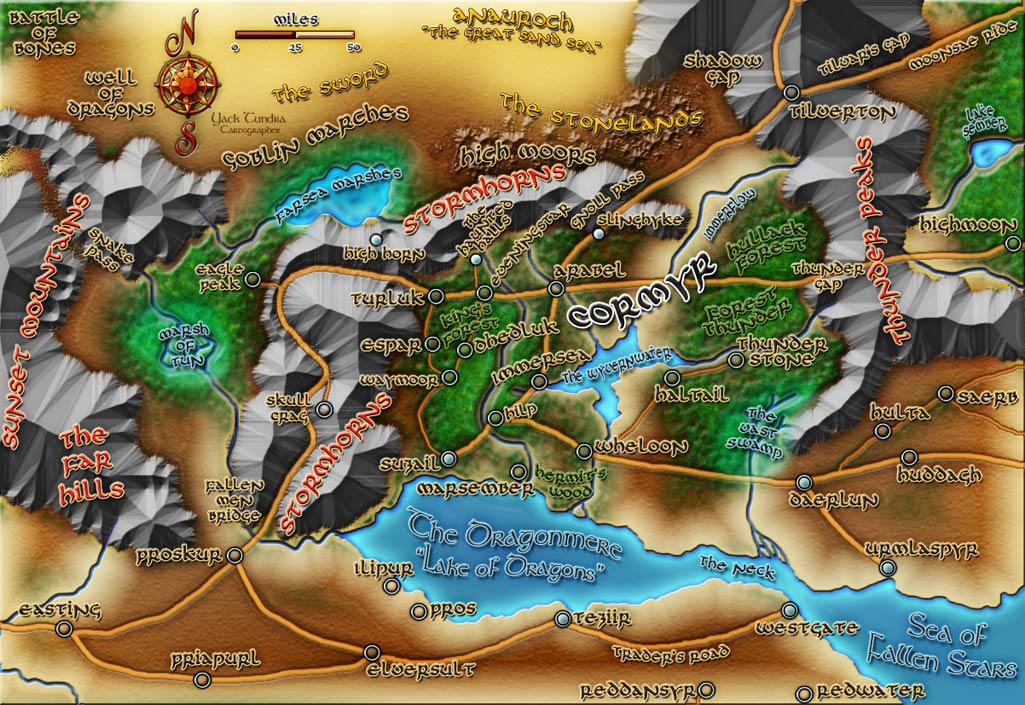

3. Quanto aos nobres, como é a divisão nobiliárquica?
Não sei se há alguma diferença da divisão de lá quanto à divisão usual que nós conhecemos, i.e. Lorde, Barão, Conde, Marquês, Duque e Arquiduque... mas compreendo que é possível comprar títulos de nobreza em Cormyr, e algumas casa mercantes já fizeram isso, algo típico da época Renascentista.
4. Um paladino de Tyr, como é a entrada na classe?
Ritual de entrada para o clero de Tyr, você está perguntando? Os livros 3.0 não mencionam, talvez o antigo livro de divindades de Faerûn para AD&D fale... caso não, poderia-se imaginar/montar algum testes simples para nível 1 que envolva justiça (aplicada ou teórica), força e resistência, sabedoria, persuasão, entre outras coisas típicas de paladinos, e eu mesmo já tenho algumas idéias, se se interessar.
5. Como é a questão de colocar um Genazi, vindo lá de Mulhorand, como seria sua relação social com os cormyrianos?
Fator raça: ele provavelmente será visto como uma excentricidade em cidades mais "abertas", com muito comércio (principalmente as cidades portuárias de Cormyr, que tem que lidar com os mais variados tipos da região), e dependendo de que tipo de genasi for e que aparência tiver, ele poderá ser temido ou admirado ou detestado (ou todos ao mesmo tempo) pelas pessoas mais comuns, embora ainda possa se provar como qualquer outro.
Fator geográfico: Mulhorand é uma nação antiga, com uma religião bem diferente, costumes variados, e que permite escravos. Esses fatores culturais podem ser vistos como estranhos para os Cormyrianos, assim como o genasi pode achar os conceitos dos Cormyrianos estranhos. Na questão política, os reinos não são aliados, porém não são inimigos, mantendo cada um sua neutralidade (especialmente visto a distância que existe entre os dois reinos). Talvez o ponto mais marcante de diferença seja o fator escravidão permitida e costumes (para ter alguma idéia de Mulhorand, pense como os Egípcios/Fenícios/Babilônios antigos, com seus reis-deuses, entre outras coisas. Alías, dá até uma boa pesquisa histórica).
Editado pela última vez por Gladius Dei em 07 Mai 2008, 13:48, em um total de 1 vez.
Inteligência é perceber que, daqui a dez anos, você será menos tolo.
Sabedoria, portanto, é compreender que você é um tolo agora.
Bom senso, por fim, é tentar não ser um tolo hoje.
- Desconhecido
(Gladius, tentando sempre ser menos tolo)
Gladius desencanou. Ele sabe quem ele é, o que faz, e o que foi feito à ele. Nada disso pode ser mudado. Procure uma contra-resposta, ela existe. Tenha um bom dia.

Sabedoria, portanto, é compreender que você é um tolo agora.
Bom senso, por fim, é tentar não ser um tolo hoje.
- Desconhecido
(Gladius, tentando sempre ser menos tolo)
Gladius desencanou. Ele sabe quem ele é, o que faz, e o que foi feito à ele. Nada disso pode ser mudado. Procure uma contra-resposta, ela existe. Tenha um bom dia.
-
Gladius Dei - Mensagens: 1677
- Registrado em: 23 Ago 2007, 15:53
Aventura em Cormyr
por Cad em 07 Mai 2008, 10:50
Obrigado, Gladius
Em relação ao Paladino de Tyr, estou no aguardo de suas ideías
Em relação ao Paladino de Tyr, estou no aguardo de suas ideías
- Cad
- Mensagens: 3
- Registrado em: 05 Mai 2008, 11:36
Aventura em Cormyr
por Cad em 07 Mai 2008, 10:54
Mias uma pergunta, os clérigos de Moradin no Reino da Floresta, como são tratados e qual seria um possível gancho para um personagem como esse?
- Cad
- Mensagens: 3
- Registrado em: 05 Mai 2008, 11:36
Aventura em Cormyr
por Khelben Arunsun em 07 Mai 2008, 12:17
Bem, Cad, nosso amigo Gladius Dei já tirou a maioria das dúvidas. Estou no trampo agora, sem acesso aos meus livros. Assim que chegar em casa, estarei dando uma atenção maior ao seu tópico.
Abraços
Abraços
"The worthy GM never purposely kills players' PCs, He presents opportunities for the rash and unthinking players to do that all on their own."
- Gary Gygax
"Don't ask me what you need to hit. Just roll the die and I will let you know!"
- Dave Arneson
Dado Mestre A Forja das Almas
- Gary Gygax
"Don't ask me what you need to hit. Just roll the die and I will let you know!"
- Dave Arneson
Dado Mestre A Forja das Almas
-

Khelben Arunsun - Mensagens: 796
- Registrado em: 02 Dez 2007, 19:01
Aventura em Cormyr
por Gladius Dei em 07 Mai 2008, 14:47
Em relação ao Paladino de Tyr, estou no aguardo de suas ideías
Bom, vai depender de quando o Paladino quer entrar na hierarquia da Igreja de Tyr... seria teoricamente possível um paladino abençoado por Tyr sem estar (ainda) filiado ao clero, e se ele decidir entrar, digamos, no nível 2-3, ele poderia, por quaisquer motivos que acreditar (não se achar digno até fazer algum feito, como poderia ser o da aventura de primeiro nível) entrar depois. Com mais poderes, mais difícil pode ser a missão, e pode se utilizar de outros poderes, como a conjuração de magias divinas, expulsar mortos-vivos, etc.
Mas a idéia básica é: testar o personagem dentro de suas capacidades. Exemplos?
- Ir atrás de um criminoso que não seja um especialista na "profissão", como um assassino de "primeira viagem". Se o personagem tem poderes investigativos/períciais sociais (Sentir Motivação/Diplomacia é da classe do Paladino), ele poderia descobrir pistas sobre quem foi (se está escondido na cidade ainda) ou para onde foi (se fugiu para o meio do mato, com medo da justiça). Se ele não tiver tanta habilidade investigativa, ele ainda pode se utilizar de sua posição como um guerreiro divino e sua carisma para conseguir alguma informação (assim como bardos, paladinos também tem uma certa fama em Forgotten Realms, apreciados pela população em geral e desrespeitados por meliantes). A seu bel prazer, pode-se adicionar se o crime foi um acidente ou não, se ele mente se foi um acidente ou não, se ele na verdade está encobrindo por alguém na cidade que mandou que ele matasse o infeliz (por temer alguma represália, como a morte de um amado, ou que seja) ou não, e se ele se entrega a justiça antes de lutar ou não. É importante ver como o paladino em questão vai agir (lembre-se, divindades de FR são bem ativas e sabem o que seus seguidores fazem, então Tyr está de olho nele num momento tão crucial): ele tem de agir de acordo com as leis do local, conforme os ditames de Tyr, e se ele desejar advogar pelo criminoso (no caso dele ser inocente/acidentado/forçado ao crime), ele pode, mas apenas através dos meios legais. Para mais considerações sobre o código dos paladinos de Tyrm em especial, recomendo ler o tópico sobre Tyr no livro Crenças e Panteões. Ou, se preferir, tem uma versão resumida aqui: http://en.wikipedia.org/wiki/Tyr_(Forgotten_Realms)
- Caçar uma criatura maligna destrutiva, como talvez um animal infernal/abissal (para nível 1, talvez um lobo infernal líder de matilha, e ele poderia ter ajuda para destruí-lo, claro. Isso poderia ser um gancho, afinal como de repente perto do vilarejo surgiu tal criatura extraplanar? Talvez algum mago tenha conjurado...). Tyr aprecia a destruição do mal.
- Resolver uma disputa legal, como dois proprietários de terras que discutem entre si as fronteiras, fazendo com que o paladino seja um mediador (um assessor jurídico pode estar disponível, de acordo com a disponibilidade do templo). Claro, disputas de terras podem ser claramente feitas de má-fé por uam das partes, ou um simples mal-entendido, como a terra disputada ser legalmente uma terra de ningué, (e daí poderia ser utilizada para que se construísse um altar para Tyr, e resolvia-se a questão).

- Fazer um rito de purificação, tal como entregar todos os seus pertences ao templo, e passar uma semana/mês vivendo de caridade, tentando compreender a justiça e injustiça como a maioria das pessoas pobres/miseráveis, e o porque de ser tão importante um organização ativa na luta contra a injustiça, e os benefícios da sociedade organizada pelas BOAS leis. Ou uma peregrinação para o maior templo da região, para fazer os sacrifícios de oferta apropriados à Tyr.
- Proteger uma relíquia menor de Tyr, que deverá ser levada de uma cidade à outra em peregrinação, ou de uma cidade pequena de onde foi descoberta para o templo principal da região. A maior chance é de que clérigos de divindades inimigas (como Bane, Cyric, Talos ou Shar) ataquem para roubar a relíquia e destruí-la. Outros guardas/paladinos em teste/grupo amigo podem acompanhar o personagem. Se a relíquia é verdadeira ou só um teste de obediência fica à seu bel prazer decidir (afinal, se for uma relíquia verdadeira e importante, eles não seriam bobos de levar assim ao léu, provavelmente várias falsas seriam enviadas ao mesmo tempo para despistar quaisquer cultos malignos. Leal e Bom não é Leal e Bobo
).- Abrir uma porta/"porta" usando de poder divino (como Expulsar Mortos-Vivos, ou uma magia divina específica), ou canalizar seu poder para alguma fonte ou local divno ao menos uma vez para fortalecer a santidade do templo (em casos onde o paladino já tenha acesso à expulsar mortovos-vivos/magias divinas). Outro poder adquirido mais para a frente é Remover Doenças, e o paladino pode ser enviado para uma área de praga para ajudar a achar a cura/cuidar dos doentes.
- Servir como diplomata/missionário entre duas cidades/nações/vilas bárbaras/igreja, ou entre sua igreja e as já mencionadas cidade/nação/vila bárbara.
Além disso, tem mais alguns detalhes, tais como:
Da Tríade (Tyr, Torm, Ilmater), Tyr é o mais proeminente em proteção e "vingar" maus-feitos, enquanto Torm caça o mal de forma ativa, e Ilmater cura. Tyr é a cabeça da Tríade, Ilmater o coração, e Torm é o Braço/Mão. Isso é interessante para demonstrar a dinâmica entre essas divindades e seus seguidores, e as igrejas de Torm e Ilmater também tem boas chances de ajudar o seguidor de Tyr como um fiel deles.
Se desejar, depois do rito de passagem, o paladino com certeza receberá alguma benção para demonstrar seu status de paladino "completo". Essa cerimônia pode ser tão simples quanto uma imposição de mãos e algumas palavras sobre a cabeça do paladino, ou tão pomposa quanto uma nomeação de cavaleiro, com: toda a história de anunciar o líder da região/religião; este fazer as perguntas sobre se ele honrará as leis da Monarquia, salvaguardará o povo e o Rei, não agirá desonradamente, e seguirá as ordens do Rei e de Tyr; receberá as esporas (e um cavalo, significando o eterno vagar do cavaleiro para proteger a nação), uma bainha consagrada em óleo (para guardar sua arma, significando que ele deve saber quando deve usar sua arma) e a espada que será tocada em seus ombros e cabeça (símbolo de justiça e autoridade, e seus dois lados afiados e temperados são justiça e compaixão, e que o cavaleiro deve sepre seguir o caminho reto da lâmina do contrário cairá do "fio da navalha").
Alías, tenho um texto aqui muito bom sobre o significado simbólico das armas e armaduras que um cavaleiro receberia em nossa época medieval, creio que isso se aplica também em Faerûn em sua maior parte:
SPOILER: EXIBIR
Espero que ajude!
P.S.: O que posso dizer? Eu SOU um fã de cavaleiros/paladinos!
Adição:
Mias uma pergunta, os clérigos de Moradin no Reino da Floresta, como são tratados e qual seria um possível gancho para um personagem como esse?
Stormhorns e Thunder Peaks tiveram comunidades anãs em seu passado, e portanto o Povo Forte (Stout People, os anões) não é desconhecido, e sim apreciados pelos Cormyrianos, já que eles construíram (às vezes em conjunto com os humanos, outras vezes para si) algumas das edificações resistentes do reino. Quando eles tinham controle das rotas comerciais nas passagens das montanhas, provavelmente eles as mantinham seguras para os mercadores da região entrarem e saírem de Cormyr, pagando-se uma taxa, claro. Hoje em dia, essa regiões estão assoladas por muitos monstros, e os anões perderam algumas cidadelas antes da Benção do Trovão. É bem provável que haja, ainda, algumas comunidades anãs nas montanhas ou próximo delas, e até algum bairro anão em Suzail.
Quanto à questão religiosa, Cormyr é tolerante para com todas as religiões boas e neutras, incluidno panteõs raciais, e só não tolera cultos malignos, com uma leve exceção talvez dos seguidores de Malar em uma de suas florestas, talvez por causa da caçada que termina em banquete que é ofertado para todas as pessoas (o único gesto de "bondade", feito para recurtar mais Malaritas), ou mais provavelmente porque o governo não consegue entrar nas florestas e extinguí-los.
Alías, anões nascidos depois da Benção do Trovão são notoriamente aventureiros e empreendedores, e eu não ficaria surpreso se algum anão, mantendo as crenças de seu Povo entre os humanos, estivesse interessado em recuperar alguma cidadela/mina anã e destruir alguns malditos orcs o goblins no processo.

Inteligência é perceber que, daqui a dez anos, você será menos tolo.
Sabedoria, portanto, é compreender que você é um tolo agora.
Bom senso, por fim, é tentar não ser um tolo hoje.
- Desconhecido
(Gladius, tentando sempre ser menos tolo)
Gladius desencanou. Ele sabe quem ele é, o que faz, e o que foi feito à ele. Nada disso pode ser mudado. Procure uma contra-resposta, ela existe. Tenha um bom dia.
Sabedoria, portanto, é compreender que você é um tolo agora.
Bom senso, por fim, é tentar não ser um tolo hoje.
- Desconhecido
(Gladius, tentando sempre ser menos tolo)
Gladius desencanou. Ele sabe quem ele é, o que faz, e o que foi feito à ele. Nada disso pode ser mudado. Procure uma contra-resposta, ela existe. Tenha um bom dia.
-
Gladius Dei - Mensagens: 1677
- Registrado em: 23 Ago 2007, 15:53
Aventura em Cormyr
por Khelben Arunsun em 19 Mai 2008, 14:01
Cad, tive a ousadia de enviar suas dúvidas para o estimado Ed Greenwood, criador de Forgotten Realms. Abaixo, segue para você a resposta do criador:
Link da resposta
Link da resposta
Hear, hear! Hearty echoings from me. Ed will provide lore to supplement George’s recent and superb Realmslore reply in this thread, but has some other replies to provide this time around, to an array of questions from a “Brazilian DM” named “Cad” (I believe) passed on to us all by Chosen of Moradin: “I´m creating an adventure based near Espar, in Cormyr, and need of some help to start with my players.
The place will be like a base for the group, the players give their character choices: a paladin of Tyr, son of a baron; a human barbarian; a sorcerer with draconic heritage that want to be a war wizard; a dwarf, priest of Moradin; a warrior of the cormyrean army; and a black earth genasi from Mulhorand(???).
Questions:
1. How can a player character enter to the War Wizards and to the Purple Dragon? (to the organizations, to the PrC is well documented).
2. There is the possibility of exist a Cormyrean barbarian? And what will be the more plausible option?
3. About the nobles, how is the organization of the Cormyrean nobility (titles, hierarchies, etc.)
4. How could I handle the "ordainment" of a paladin of Tyr
5. How could I handle a presence of a Mulhorand genasi, how the Cormyreans will interact with him?”
Ed replies:
For joining the War Wizards: the sorcerer will be required to register (give his name, place of origin, intended place of dwelling or route of travel within the realm, blood sample, and sigil if any) with the War Wizards, just as any arcane spellcaster is. If he expressly asks to join the Wizards of War, he’ll be told (by any War Wizard NPC) the polite equivalent of “Don’t call us; we’ll call you.” However, he will also be watched covertly and closely from that moment on (including by War Wizards using spells to spy on him and listen to his utterances, from afar). The War Wizards want all adventurer-wizards active in Cormyr to be bound by adventuring charter, or to leave the realm, or to serve the Crown, or to join their ranks, so unless the sorcerer is a “bad apple” (flouts the laws and behavioural norms of the kingdom often and casually), he will eventually be asked to join. Which will mean he ends up serving as a spy or open reporter on the deeds of his adventuring companions, and can be ordered (usually by a testy Vangerdahast or another senior gruff old Wizard of War, if your Realms campaign has the War Wizards run by someone else, such as Caladnei) to undertake all sorts of dangerous tasks (read: ways you the DM can drag the PCs into adventures) at any time. The actual joining will involve mind-reaming (an exhausting mind-meld spell in which a senior War Wizard who can easily mentally overpower the PC sorts through all of the PC’s memories and sees EVERYTHING, so let’s hope the PC doesn’t have too shady a past) and then the swearing of an oath. An example of a mind-reaming can be seen in my novel ELMINSTER’S DAUGHTER; the oath appears in my 2004 questions thread here at the Keep, I believe (Sage? Kuje? Wooly? Alaundo? where is it, exactly, please? :}).
For joining the Purple Dragons: the soldiery of Cormyr is always short of strength, these days, and simply volunteering at any garrison location is enough to get a PC “halfway in.” There’s an oath of loyalty (simplify it from the War Wizard one, with loyalty sworn to the ruling monarch; if your campaign is during the Steel Regency, the oath will specify serving Azoun V directly or “through the Regent, and none other”), the signing of a “bond” (simple contract, with pay specified; the PC will start as an “armsman” or trainee soldier, at 1 cp/day plus room and board; pay will increase to 1 sp/day for any sort of “combat duty,” and mounts and all gear are provided free of charge; pay will also increase as more training is mastered, and of course increases with rank; there are various notations over the three-and-ongoing years of this thread as to pay, rank, et al, plus the rank table given in POWER OF FAERUN), mind-reaming again (by a middling-level War Wizard), and then assignment to a trainee “patrol” at a garrison.
Please note: whereas PC adventurer War Wizards are typically “fairly free” to go adventuring, PC Purple Dragons are NOT. Being a soldier of the Crown means military duty, darned near all your waking hours, not racing off to delve into dungeons or pick fights with monsters or anyone else. Trainees are not going to be sent into danger or anywhere near any royalty or sensitive areas, unless the realm gets plunged suddenly into war.
No, there are no Cormyrean barbarians. Which doesn’t mean there can’t be a “barbarian” IN Cormyr. This would most likely be an unlettered, untutored “backwilds” human who’s wandered south from a subsistence-level family in the northernmost reaches of Thar or the Sword Coast North (Ice Mountains vicinity, or fled from a more westerly Uthgardt tribe thanks to a blood feud, oathbreaking, or other trouble; any human from the Sword Coast North is likely to have been displaced by strengthening orc activity). There’s also the slim possibility of having come from subsistence-level Nar or other human family from somewhere between the Great Dale and Sossal, but you’ll have to come up with “how the character got to Cormyr.” Myself, I’d use a gate/portal, but then you’ll have to decide if the character can find or use that gate again, or (preferably) if it’s been lost or destroyed.
The nobility of Cormyr are a large and complicated topic that I haven’t even begun to address properly in print. Pre-Spellplague, there may be as many as 120 noble families, if you count all of the exile, banished, possibly-extinct ones. There are generally about forty wealthy and influential noble families in Cormyr, with a dozen or so really powerful ones that a PC “son of a baron” can’t possibly be from. Most of them are called “lord” or “lady” in general daily parlance; there aren’t enough “barons” in Cormyr for a PC to easily be from a Cormyrean family and still be the “son of a baron.” I’d suggest that the PC either be from the Cormaeril family (recently lost noble status and most wealth and lands, though individuals are still allowed to serve the Crown as soldiers, earn ranks and titles, and remain as citizens, perhaps becoming ennobled in the future in their own right rather than because of their blood) or an exiled family (again, is the son of a baron but that now means nothing except suspicion in Cormyr), or hales from the nobility of Chessenta or perhaps Tethyr. As a DM, consider carefully what advantages you are handing the PC if they can call on noble privileges, wealth, and connections whenever they feel the need.
As for the ordainment of a paladin of Tyr, there are two elements here: the “Trueing” (the official ceremony or ritual in which a paladin is “sanctified” to “ride forth as an arm of Tyr,” dispensing justice, fighting injustice, and generally being a paladin in the name of the god, able to call upon and even command the support of His church), and the “Testing” that leads up to this ceremony: the Great Task that anyone desiring to become a paladin must successfully complete in order to be granted paladinhood.
I would suggest that a PC paladin begin play by having to carry out this Task with the aid of a “band of companions” (the rest of the PCs) so as to force him or her to become part of a team rather than being the loner he/she has hitherto been, and that this Task be some sort of dangerous adventuring mission in Cormyr, perhaps recovering a holy relic stolen from a temple of Tyr by someone wealthy and powerful in Cormyr (a senior courtier, a noble, or a wealthy and powerful merchant in one of the three cities; in other words, a major and tricky task). If the PC fails, there may be severe social consequences for all of the PCs in Cormyr, but the Church of Tyr understands that daring and danger holds forth the possibility of failure, and will merely assign another Task. HOW the PC paladin carries out the task is of utmost importance: he/she must try their utmost not to break any laws, and not to create any injustice by their deeds and words or through what they failed to say or do. Simple for me to outline, but can be VERY hard for a player to guide their character through, without missteps, in the hands of a good DM.
Cormyr is a tolerant, “crossroads” trading land; citizens of all of its three cities and all waystop communities along its central and eastern roads are used to seeing all manner of “strange outlanders.” Unless they look very like a known or legendary “dangerous monster” (for most Cormyreans, known monsters include carrion crawlers, doppelgangers in their “native” form or seen during shapeshifting, and goblins; legendary perils include drow, illithids, and dragons), the treatment a particular “outlander” receives depends on how he or she behaves. A black earth genasi from Mulhorand would be ridiculed if trying to make a living as, say, a lap dancer in a high-end city festhall or club, an attendant arranging tiny fragile ceramics or jewelry pieces in a crowded shop, or perhaps a fashion model, but would otherwise generally be treated as “just another trader” or laborer (“Ho, touch of giant blood in that one, I’d say!”). On the other hand, a black earth genasi from Mulhorand who set up a bone altar and prayed to orc gods would get attacked, pronto. If the player handles the PC according to what RACES OF FAERUN says about the attitude and demeanor of most earth genasi, the character should be accepted readily by Cormyreans (though they may glance at him or her twice, or stare with interest, just because the character is a tad “different” and therefore interesting).
So saith Ed, who remains frantically busy, and begs your patience as he continues to make Realmslore replies when he can. Keep those questions (and rants and hellos and everything else, too) coming.
love to all,
THO
"The worthy GM never purposely kills players' PCs, He presents opportunities for the rash and unthinking players to do that all on their own."
- Gary Gygax
"Don't ask me what you need to hit. Just roll the die and I will let you know!"
- Dave Arneson
Dado Mestre A Forja das Almas
- Gary Gygax
"Don't ask me what you need to hit. Just roll the die and I will let you know!"
- Dave Arneson
Dado Mestre A Forja das Almas
-
Khelben Arunsun - Mensagens: 796
- Registrado em: 02 Dez 2007, 19:01
7 mensagens
• Página 1 de 1
Voltar para Sistemas e Cenários
Quem está online
Usuários navegando neste fórum: Nenhum usuário registrado e 1 visitante